Special Meeting Board Recap December 29, 2025

MUDucation Recap: The Night the Board Voted Themselves a Legal Slush Fund
If you ever wondered what it looks like when a board stops pretending and just goes full mask-off, the December 29, 2025 Special Meeting delivered.
Tucked neatly into the agenda—like a stocking stuffer nobody asked for—was a resolution authorizing four board members to use public funds to pay for their personal lawsuits. Not lawsuits involving district operations. Not lawsuits defending the MUD. Personal lawsuits. Against residents. For speaking out.
And just like that, the board tried to vote the Texas Constitution out of existence.
By a 4–1 vote, the board adopted a resolution granting themselves permission to spend taxpayer dollars on their own legal fees stemming from litigation they filed against their constituents.
No findings of public purpose.
No explanation of district benefit.
No safeguards.
Just a collective shrug and a “we say it’s fine.”
For those keeping score at home, here’s what that vote attempted to bulldoze:
Texas Constitution, Article III, §52(a) — prohibits public funds being spent for private benefit.
Texas Constitution, Article XVI, §13 — makes unlawful authorization itself actionable.
Texas Water Code §49.083 — requires directors to act solely in the best interest of the District.
Texas Penal Code §39.02 — misuse of public funds by public servants.
But hey—why let “law” interfere with convenience?
Context Matters (So Let’s Add Some)
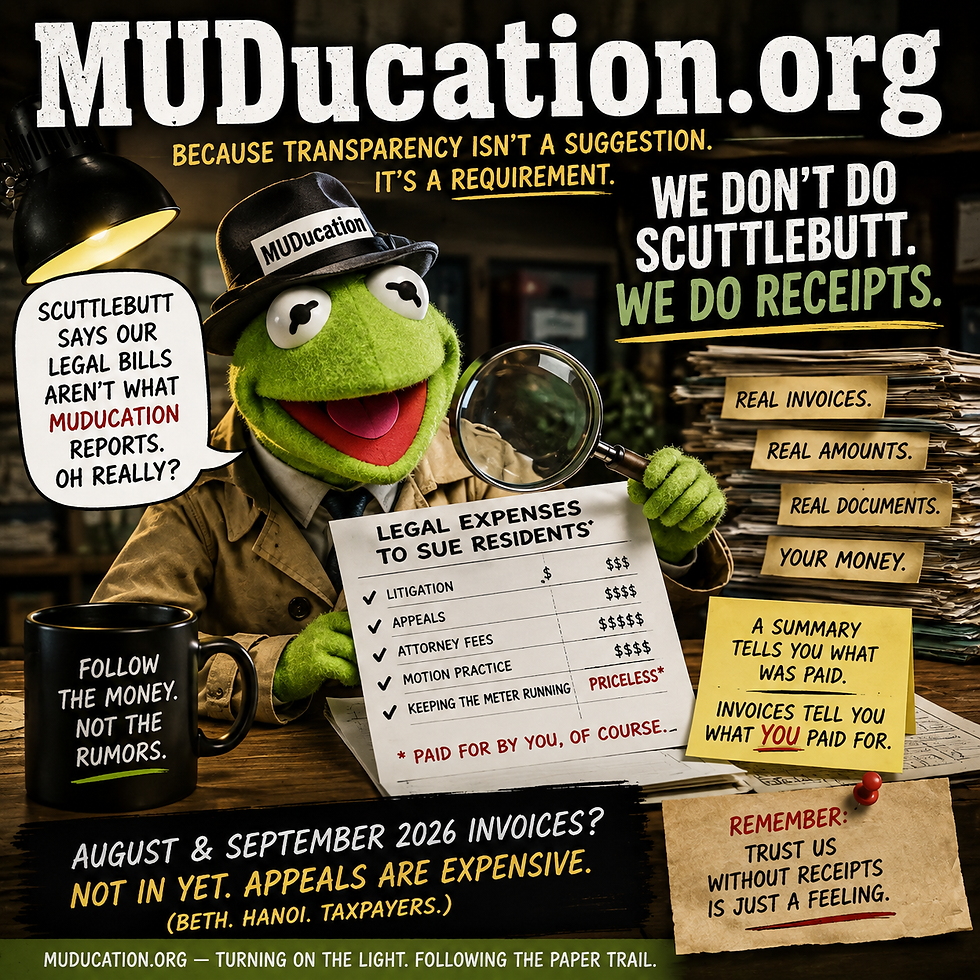
Back in May 2025, the District—yes, the MUD itself—filed a lawsuit against 3 residents, 1 former resident for exercising their First Amendment rights. That case didn’t go well.
The court dismissed the District’s First Amended Petition under the Texas Citizens Participation Act and ordered the MUD to pay roughly $120,000 in the defendants’ legal fees. Add in the District’s own lawyers, and taxpayers are now north of $300,000 into this exercise in ego management.
Undeterred, the board filed a Third Amended Petition, this time packed with allegations that are plainly personal to individual board members—not district business, not statutory duties, just grievances wearing official letterhead.
Which brings us back to December 29.
Rather than paying for their own lawyers like normal people, four directors decided the District should pick up the tab. Because apparently, suing your neighbors for criticizing governance is now a “district purpose.”
The Question No One Answered
Not once during the meeting did anyone explain:
How does funding personal lawsuits against residents benefit the District?
Because it doesn’t.
What it does do is:
Convert public money into a private legal defense fund
Chill resident speech
Expose the District to illegal-exaction claims
Hand prosecutors a neatly wrapped evidentiary bow
Final Grade
Transparency: ❌
Public purpose: ❌
Legal authority: ❌
Audacity: ✅✅✅
If this vote felt wrong to you, trust that instinct. The Constitution felt that way too.
Stay tuned. Receipts are a thing.
— MUDucation