General Board Meeting Recap: October 15, 2025

Updated: Nov 19, 2025
Attendance: Directors Flores and Jones were absent, leaving the evening in the hands of the Three Stooges. Rent-a-Cop was also missing, demonstrating yet again that his presence has never been essential to anything other than the snack table.
The Overhead Projector Resurrection Attempt
The meeting began with a lengthy struggle to revive the overhead projector, which has been inoperable for more than four years. The Inframark operator insisted it was “a new one,” though no one present had the faintest idea how to turn it on, let alone use it.
The intended purpose? Hanoi Avila hoped to display proof that the vengeance-and-retribution lawsuit he and Jones devised is still staggering around in the court system. He appears oddly proud of spending public funds to pursue his personal grudges and seems blissfully unconcerned about the First Amendment or its continued existence.
It is true that the entire case is not dismissed. Yet. But filings to dispose of what remains are already in motion.
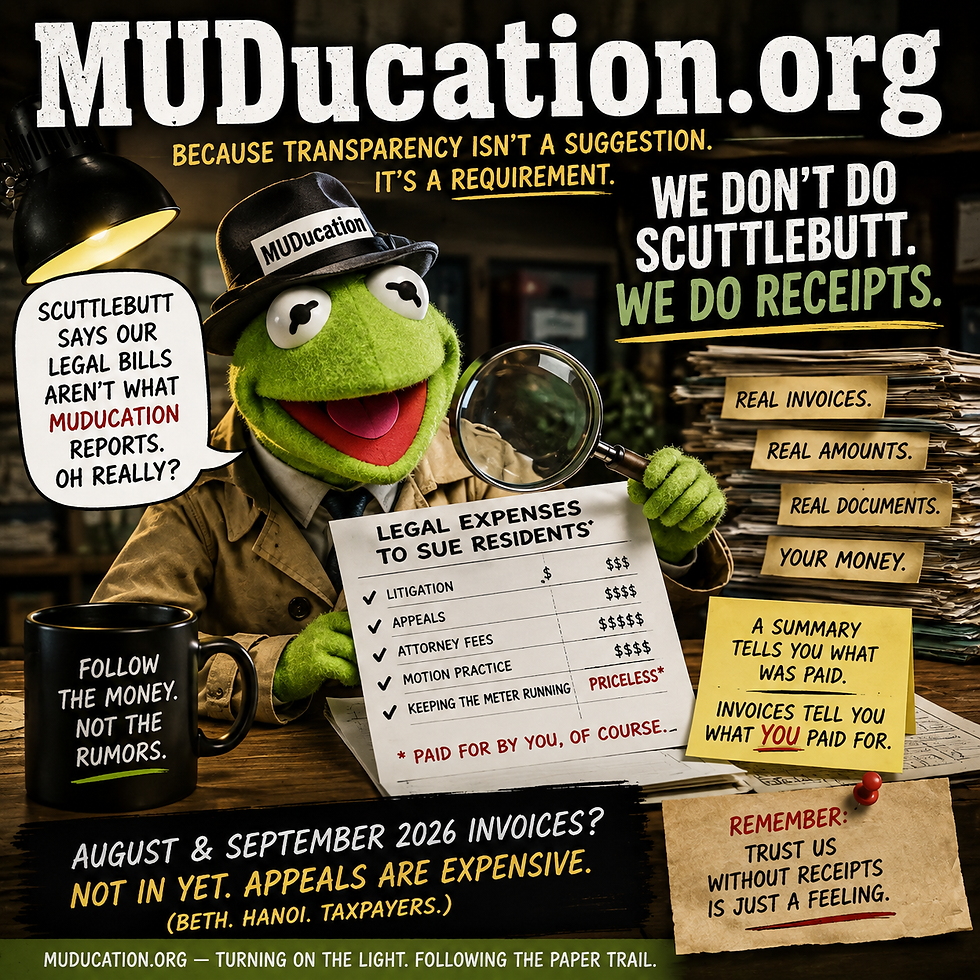
True transparency would mean posting all documents to the District’s website—just as they are posted here in MUDucation. One can dream.
Consent Agenda Confusion, Act VII
The attorney once again explained the purpose of a consent agenda: no discussion, pay the bills, approve the minutes, move on with life.
Three hands immediately shot up to approve without discussion. Then Rocco, perhaps wanting to contribute something, anything, moved to approve the minutes—demonstrating that he neither listened nor grasped the point.
Financial Status Report
The District’s financial advisor joined remotely to report that the District is in a stable financial position with enough funds to cover a full year of operating expenses (based on the questionable budget posted online).
This news did not calm the waters.
Director Avila promptly declared that the District should pursue more bond debt. Why? So he can have access to more unrestricted cash for frivolous lawsuits and spending unrelated to water services. He suggested the taxpayers should be grateful for his decision-making. The statement was delivered without irony.
A Reminder of the Five-Year Plan They Ignore
In 2024, the District’s engineer produced a comprehensive five-year WATER infrastructure plan—fully fundable through existing annual tax revenue. No bonds required. No borrowing necessary. Just responsible maintenance and planning.
Included in that plan was a gradual conversion from analog to electronic meters. This “replacement project” officially began in 2018 with ten “test properties”—all belonging to board members and their friends. Shockingly, no test results were ever presented publicly and questions concerning the project were never answered.
For years afterward, the District purchased $50,000 worth of electronic meters annually and stored them at CubeSmart until 600 accumulated. Those were eventually installed under the premise that only high-volume meters (200,000+ gallons) needed replacement. In reality, some replaced meters had seen as little as 10,000 gallons.
Electronic meters also come with lifetime subscription fees—similar to cell phone data plans. The District has already been paying these fees for over a year, yet property owners still have not been given instructions on how to access the EyeOnWater service.
Meanwhile, Inframark has continued to receive full payment as though all meters are still being read manually and has announced there will be no reduction even after full conversion.
Electronic meters are not essential. They are a “nice-to-have,” born out of vendor conference hospitality rather than actual district needs. This is the same era that brought us four solar speed signs purchased in 2018 that have never seen daylight.
The Bond Vote
When the time came to vote on pursuing additional bond debt, four hands rose in perfect unison. Nothing enables fiscal carelessness quite like borrowed money.
Final Thought
And with that, we conclude another meeting in which the District manages to prove, with admirable consistency, that the bar can always be lowered a little further. Nothing dramatic, nothing explosive—just a steady drip of small decisions that erode trust more effectively than any burst pipe ever could.
Should clarity, prudence, or genuine public service ever attempt to make an appearance, they would no doubt be postponed to a later agenda item and quietly forgotten.
Until next month, when we gather again to watch the slow, deliberate art of governance-by-avoidance, I encourage you to stay informed, stay patient, and remember: the water may be clear, but the leadership certainly isn’t.